What Is BNB? How It Works, Uses and Risks
BNB is the native coin of BNB Chain, used to pay gas fees, stake with validators and get Binance discounts. Its 200M supply shrinks through quarterly burns.
In this guide
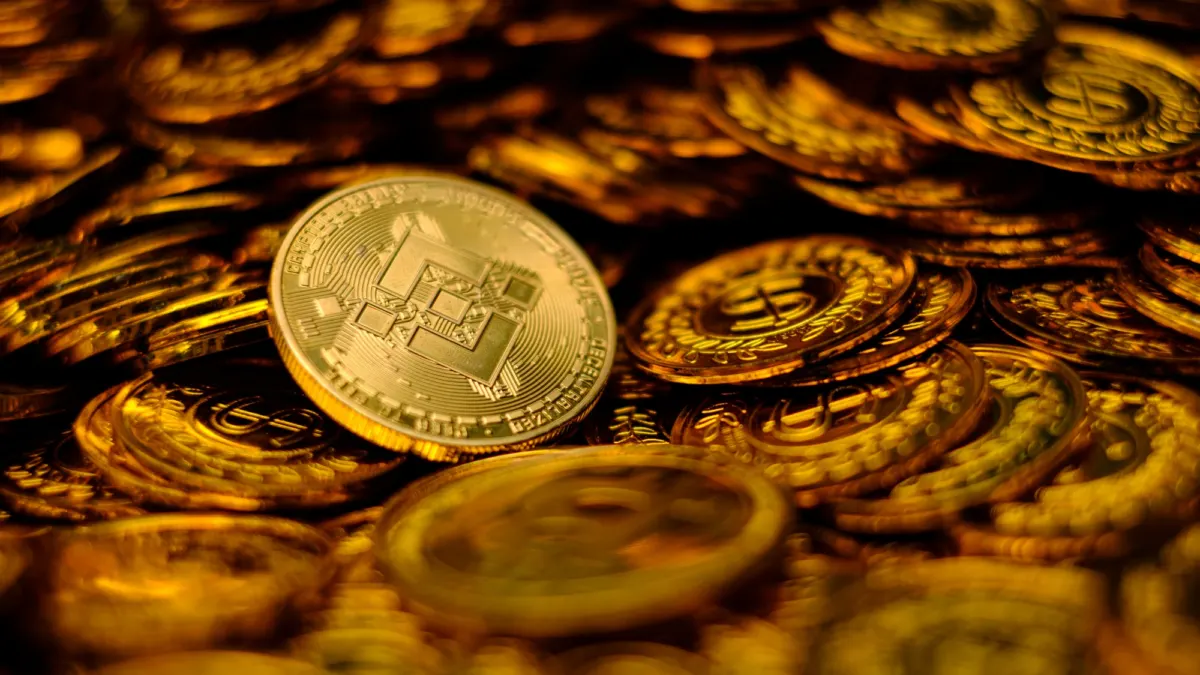
BNB is the native cryptocurrency of BNB Chain, a group of blockchains originally built by the crypto exchange Binance. You use BNB to pay transaction fees on BNB Smart Chain, to stake with the validators that secure it, and to get discounts and access to token sales on Binance. If you are asking “what is BNB?”, the short answer is: an exchange token that grew into the fuel of one of the busiest smart contract networks in crypto.
BNB launched in 2017 as a discount token for Binance users. It has since moved to its own blockchain, picked up a quarterly burn program that permanently removes coins, and become one of the five largest cryptocurrencies by market capitalization. That growth has come with an unusual dependence on a single company, which is the main thing to understand before you hold any.
This guide explains where BNB came from, how BNB Chain works, what the coin is used for, how its supply shrinks over time, what the ecosystem looks like, and the specific risks that come with it.
What Is BNB? The Short Version
BNB (originally “Binance Coin”, now officially “Build and Build”) is a utility token: a token whose main job is to be spent or used inside a system rather than to represent ownership of a company. It does three jobs at once.
- Gas token: every transaction on BNB Smart Chain (BSC) and its layer 2, opBNB, pays its fee in BNB. Gas is the unit that measures how much computation a transaction uses.
- Staking token: validators, the computers that produce blocks, must lock up BNB, and holders can delegate BNB to them to earn a share of fees.
- Exchange perk: on Binance, holding or spending BNB gives you lower trading fees and access to token launch programs.
Unlike bitcoin, BNB was not mined into existence. All 200 million coins were created at launch, and the total has only gone down since, through scheduled burns.
Who Created BNB? From Exchange Token to BNB Chain
Binance was founded in 2017 by Changpeng Zhao, widely known as CZ. To fund the exchange, Binance held an initial coin offering (ICO) in July 2017, selling BNB to the public for about $15 million. The original allocation of the 200 million coins was:
- 100 million (50%) sold to the public in the ICO
- 80 million (40%) to the founding team
- 20 million (10%) to angel investors
At first BNB was an ERC-20 token living on Ethereum. Key milestones since then:
- April 2019: Binance Chain (later called BNB Beacon Chain) launched, and BNB moved to its own network. That chain was fast but could not run smart contracts.
- September 2020: Binance Smart Chain launched as a parallel chain compatible with the Ethereum Virtual Machine (EVM), so Ethereum apps and wallets could run on it with few changes.
- February 2022: the networks were rebranded as BNB Chain, and Binance began presenting it as a community-run ecosystem rather than an exchange product.
- 2023: opBNB (a layer 2 network) and BNB Greenfield (a decentralized storage network) launched.
- 2024: the old Beacon Chain was shut down in a migration called BNB Chain Fusion, leaving BNB Smart Chain as the main network.
Binance itself has had serious legal trouble. In November 2023, Binance pleaded guilty in the US to anti-money-laundering and sanctions violations and agreed to pay about $4.3 billion, and CZ pleaded guilty and stepped down as CEO. A separate SEC lawsuit against Binance was dismissed in May 2025, and CZ received a US presidential pardon in October 2025. None of this changed how BNB Chain runs, but it shows how much news about one company can move the coin.
BNB Chain Explained: How the Network Works
When people say “BNB Chain” today, they usually mean BNB Smart Chain (BSC), the layer 1 blockchain where most activity happens. It uses a consensus system called Proof of Staked Authority (PoSA), a mix of proof of stake and a small, elected validator set.
Validators and Proof of Staked Authority
According to BNB Chain’s documentation, a daily election after 00:00 UTC picks the 45 validators with the most BNB staked to them. The top 21 are called Cabinets and the other 24 Candidates. In each round, 18 Cabinets and 3 randomly chosen Candidates take turns producing blocks. A validator must self-stake at least 2,000 BNB, and one caught signing two conflicting blocks loses 200 BNB and is jailed for 30 days.
A small validator set is why BSC is fast and cheap. It is also why critics call it centralized: compare 45 active validators with the hundreds of thousands of validator keys on Ethereum. If you want the background on these trade-offs, see our guide to proof of stake vs proof of work.
Speed and fees
BSC has been getting faster through a series of hard forks (network-wide software upgrades). Block times fell from 3 seconds to 0.75 seconds in 2025, and the Fermi hard fork on January 14, 2026 cut them to about 0.45 seconds, according to BNB Chain. Validators also lowered the minimum gas price to 0.05 gwei in October 2025. One gwei is one billionth of a BNB.
Example: A simple BNB transfer uses 21,000 gas. At 0.05 gwei per unit of gas, the fee is 21,000 x 0.05 = 1,050 gwei, or 0.00000105 BNB.
If BNB were priced at a hypothetical $1,000, that fee would be 0.00000105 x $1,000 = about $0.001. A token swap using 150,000 gas would cost 150,000 x 0.05 = 7,500 gwei = 0.0000075 BNB, or about $0.0075 at the same price.
Because BSC is EVM-compatible, fees are calculated the same way as on Ethereum: gas used multiplied by the gas price. The difference is that BSC gas prices are set far lower.
opBNB and BNB Greenfield
opBNB is a layer 2 built with the OP Stack (the same open-source code behind Optimism and Base). It batches transactions and posts them to BSC, which lowers costs further for high-volume apps such as games. BNB Greenfield is a storage network where users pay in BNB to store data that smart contracts on BSC can reference. Both use BNB as their gas token.
What Is BNB Used For?
BNB’s uses fall into two groups: on-chain (anything that happens on BNB Chain) and on Binance itself.
On BNB Chain
- Paying gas fees for transfers, swaps, lending, NFT trades and smart contract calls on BSC and opBNB.
- Staking with validators to help secure the chain and earn a share of fees. Native staking on BSC currently has a 7-day unbonding period, meaning your BNB stays locked for a week after you ask to withdraw.
- Collateral and liquidity in decentralized finance (DeFi) apps, for example as collateral on lending markets such as Venus or in trading pools on PancakeSwap.
- Governance: staked BNB can be used to vote on BNB Evolution Proposals (BEPs), the formal process for changing the protocol.
On Binance
- Trading fee discounts when you choose to pay fees in BNB. Binance has long offered a 25% discount on spot trading fees this way; check the current fee page because rates change.
- Launchpool and similar programs, where you lock BNB to receive new tokens before they list.
- Payments through Binance Pay and some third-party merchants and travel sites.
For context on how BNB fits into the wider set of non-bitcoin coins, see our guide to altcoins and how they differ.
BNB Supply, Burns and Tokenomics
BNB has a fixed maximum of 200 million coins and no new issuance. Validators are paid from transaction fees, not freshly minted coins. Supply falls in two ways.
Quarterly Auto-Burn
Since late 2021, the BNB Foundation runs an Auto-Burn every quarter, sending coins to an address no one controls. The amount is set by a public formula rather than by Binance’s profits:
Burn amount = N x 1,000 / (P + K)
Here N is the number of blocks produced in the quarter (counted in 3-second equivalents so faster blocks do not distort it), P is the average BNB price in dollars, and K is a price anchor that started at 1,000 and can be adjusted. The program continues until total supply reaches 100 million BNB.
Example: A 92-day quarter contains 92 x 28,800 = 2,649,600 three-second intervals. With a hypothetical average price of $1,000 and K = 1,000:
2,649,600 x 1,000 / (1,000 + 1,000) = 1,324,800 BNB burned.
If the average price were $500 instead: 2,649,600,000 / 1,500 = 1,766,400 BNB. A lower price means more coins burned, so the dollar value of the burn is more stable than the coin count.
Real-time gas burn
A second mechanism, introduced by BEP-95 in 2021, burns a fixed share of the gas fees in every block on BSC as it is produced. This is similar in spirit to Ethereum’s fee burn, though much smaller in scale.
Supply as of October 2026
The 37th quarterly burn, completed on October 19, 2026, removed about 1.65 million BNB and left total supply at roughly 131.5 million BNB, as of October 2026. That is about 34% below the original 200 million. Check bnbburn.info or BscScan for the live figure.
Keep the founding allocation in mind too. The team’s 80 million coins vested over several years and Binance still holds a large amount, so a small number of entities control a meaningful share of supply. There are no remaining scheduled token unlocks of the kind many newer coins have.
The BNB Chain Ecosystem
BNB Smart Chain hosts thousands of apps. It tends to attract users who want Ethereum-style apps at a fraction of the cost, and it has a strong following in Asia, Africa and Latin America. Notable categories include:
- Decentralized exchanges: PancakeSwap, one of the largest DEXs by volume across all chains.
- Lending: Venus, Lista and other money markets, plus liquid staking tokens that represent staked BNB.
- Stablecoins: large balances of USDT and USDC circulate on BSC for payments and trading.
- Memecoins and launchpads: token launch platforms such as Four.meme have made BSC a hub for memecoin trading, with all the risks that implies.
- Bridges: tools that move tokens between BSC and other chains. In October 2022, an attacker exploited the BSC Token Hub bridge to mint 2 million BNB, and validators halted the chain for several hours to contain it. That pause showed both quick crisis response and how few parties it takes to stop the network.
BNB vs Ethereum vs Solana
BNB Smart Chain competes most directly with Ethereum, which it copied technically, and with Solana, which competes on speed and cost. Here is how they compare on stable design features.
| Feature | BNB (BNB Smart Chain) | Ethereum (ETH) | Solana (SOL) |
|---|---|---|---|
| Launched | 2017 (token); 2020 (smart chain) | 2015 | 2020 |
| Consensus | Proof of Staked Authority, 45 active validators | Proof of stake, very large validator set | Proof of stake, about 1,000+ validators |
| Block time | About 0.45 seconds (since January 2026) | 12 seconds | Well under 1 second |
| Supply model | Fixed 200M max, shrinking via burns toward 100M | No cap; issuance offset partly by fee burn | No cap; inflation declining toward 1.5% |
| Smart contracts | EVM-compatible (Solidity) | EVM (Solidity, Vyper) | Solana Virtual Machine (Rust) |
| Main trade-off | Cheap and fast, but closely tied to Binance | Most decentralized, costlier base layer | Fast and cheap, history of outages |
For a deeper look at the other two, see our guides to Ethereum and Solana.
How to Buy and Store BNB Coin
- Pick a regulated platform where you live. BNB is listed on Binance and many other large exchanges. US residents cannot use Binance.com; Binance.US is a separate company with a smaller listing set, and other US exchanges also list BNB. Availability varies by country.
- Verify your identity and fund your account with a bank transfer or card.
- Buy BNB with a market or limit order, and check the fee before confirming.
- Decide where to keep it. Leaving BNB on an exchange is convenient but means trusting that company. To hold it yourself, withdraw to a wallet that supports BNB Smart Chain, such as MetaMask, Trust Wallet or a hardware wallet. Our guide to crypto wallets explains the options.
Pick the right network when withdrawing. BNB exists on BNB Smart Chain (often labeled BEP-20), on opBNB, and as wrapped tokens on other chains. Sending to an address on the wrong network can lose your funds. Send a small test amount first, and keep a little BNB in your wallet to pay future gas fees.
Risks of BNB
- Company concentration. BNB’s value is closely linked to Binance’s business and reputation. Regulatory action, a hack or a change in Binance’s fee perks could hit BNB directly, regardless of how the blockchain performs.
- Regulatory risk. Exchange-issued tokens attract regulators’ attention. Binance’s 2023 US guilty plea and multiple national-level actions show the scale of this exposure. Rules differ by country and can change quickly.
- Centralization. 45 active validators, with many linked to large companies, means the chain can be coordinated or halted, as it was in 2022. That helps in emergencies but weakens censorship resistance.
- Smart contract and bridge risk. Many BSC apps are forks of Ethereum code with less auditing. Rug pulls and exploits are common, especially among memecoins. Read our guide to common crypto scams before trying new tokens.
- Price volatility. Like any crypto asset, BNB can fall sharply in short periods. Burns reduce supply, but they do not guarantee a higher price.
Bottom Line
BNB is the gas, staking and perk token of BNB Chain, with a capped supply that shrinks every quarter through a transparent burn formula. Its network is fast and cheap, but that speed rests on a small validator set and a close relationship with Binance. If you hold BNB, you are betting partly on a blockchain and partly on one company, so size any position with that in mind. You can explore more coin profiles from our crypto hub.
Sources
Frequently asked questions
What is BNB used for?
BNB pays transaction fees on BNB Smart Chain and opBNB, is staked with validators to secure the network, and serves as collateral in DeFi apps. On Binance it also gives trading fee discounts and access to new token programs such as Launchpool.
Is BNB the same as Binance?
No. Binance is a company that runs a crypto exchange; BNB is a cryptocurrency that Binance created in 2017. BNB now runs on BNB Chain, which is presented as community-run, but Binance remains closely involved and its fortunes still strongly affect BNB.
What is BNB Chain explained simply?
BNB Chain is a family of networks led by BNB Smart Chain, a fast, low-fee blockchain compatible with Ethereum apps. It also includes opBNB, a layer 2 for even cheaper transactions, and BNB Greenfield for data storage. All of them use BNB for fees.
Does BNB coin have a max supply?
Yes. BNB started with 200 million coins and no new coins are minted. Quarterly burns and a real-time gas burn reduce supply, with a target of 100 million BNB. Total supply was about 131.5 million as of October 2026.
Can US residents buy BNB?
US residents cannot use Binance.com, but BNB is available on Binance.US and some other US exchanges, depending on your state. Check the platform's availability and fees for your location before signing up.
Is BNB a good investment?
No one can tell you that with certainty, and TradingDots does not give buy or sell advice. BNB has real use as a gas token and a shrinking supply, but it also carries concentrated company and regulatory risk. Only invest money you can afford to lose and consider how it fits a diversified portfolio.
Keep learning
What Is a Memecoin? How They Work and Why They’re So Risky
A memecoin is a crypto token driven by internet jokes and hype rather than any product or cash flow. Most…
What Is Solana? How It Works and How It Compares to Ethereum
Solana is a fast proof-of-stake blockchain that settles transactions for fractions of a cent. Its token, SOL, pays fees and…
What Are Altcoins? Types, Examples and Risks
Altcoins are all cryptocurrencies other than bitcoin, from platforms like Ethereum and Solana to stablecoins, exchange tokens and memecoins.