Hot Wallet vs Cold Wallet: Differences, Pros and Cons
A hot wallet keeps your crypto keys on an online device for easy spending; a cold wallet keeps them offline, making remote theft far harder.
In this guide
- What Is the Difference Between a Hot Wallet and a Cold Wallet?
- Cold Wallet vs Hot Wallet: Detailed Comparison
- Threat Models: What Each Wallet Protects Against
- Pros and Cons of Hot Wallets
- Pros and Cons of Cold Wallets
- What Is a Warm Wallet?
- Is a Cold Wallet Better? How to Split Your Holdings
- How to Move Funds Safely With a Test Transaction
- Bottom Line
- Sources
Cold wallet vs hot wallet: the difference comes down to one thing, whether your private keys ever touch an internet-connected device. A hot wallet keeps the keys on your phone or computer, so it is fast and free but exposed to online attacks. A cold wallet keeps the keys offline, usually on a hardware device, so it is slower to use but far harder to hack remotely.
Most people who hold crypto for long end up using both, the same way you might carry a little cash in your pocket and keep your savings in a bank. The real question is not which one is better in general, but how much you should keep in each and how you move money between them safely.
This guide gives you a detailed comparison table, explains the threats each type protects against, covers the “warm wallet” middle ground, and walks through a worked example of splitting your holdings, plus a step-by-step test transaction routine.
What Is the Difference Between a Hot Wallet and a Cold Wallet?
Every crypto wallet stores private keys, the secret numbers that authorize spending from your addresses. Your coins themselves stay on the blockchain. If the idea of keys is new, read our explainer on what a crypto wallet is and how it works first.
A hot wallet stores and uses its keys on a device that is online, or regularly goes online. Examples include mobile wallet apps, browser extension wallets such as MetaMask or Rabby, desktop wallets and the wallets inside crypto exchanges. When you approve a transaction, the signing happens on that internet-connected device.
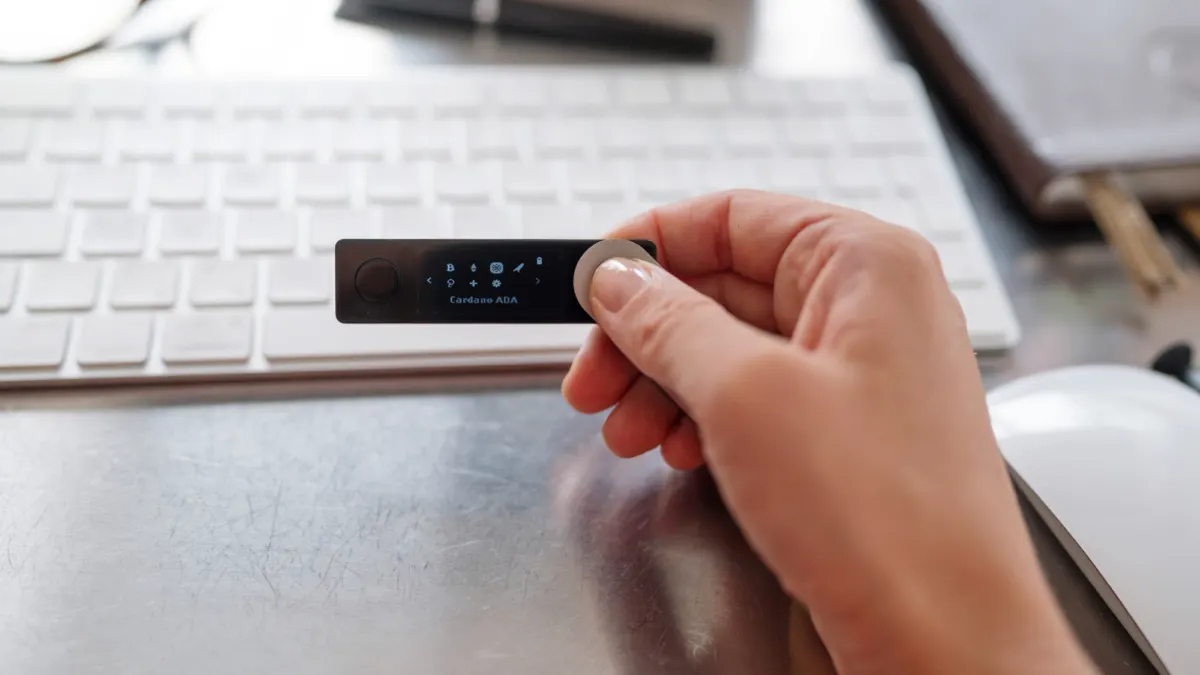
A cold wallet stores its keys somewhere that never connects to the internet. The most common example is a hardware wallet, a small dedicated device from makers such as Ledger, Trezor, Coldcard or Keystone. It signs transactions inside the device and passes back only the signed result. Other forms of cold storage include fully “air-gapped” devices that communicate only by QR code or memory card, and older paper wallets.
One nuance matters a lot: your cold wallet still needs a hot device to broadcast transactions. You build the transaction in an app on your computer or phone, the hardware wallet signs it, and the app sends it to the network. The key never leaves the device, which is the whole point.
Cold Wallet vs Hot Wallet: Detailed Comparison
| Factor | Hot wallet | Cold wallet (hardware) |
|---|---|---|
| Where keys live | On an internet-connected phone, computer or exchange server | On an offline device or air-gapped storage |
| Upfront cost | Usually free | Roughly $50–$400 per device, depending on model |
| Setup time | A few minutes | 20–60 minutes, including writing the seed phrase |
| Speed of use | Seconds; ideal for frequent transactions | Slower; you need the device and must confirm on it |
| Exposure to malware and remote hacks | High; anything that compromises the device can reach the keys | Low; keys never leave the device |
| Protection from phishing approvals | Weak; one click can sign a malicious transaction | Better; you must physically confirm, but can still be tricked into approving |
| Physical theft risk | Stolen unlocked phone can be drained | Device is PIN-protected and wipes after repeated wrong PINs on most models |
| Loss risk | Recoverable from seed phrase | Recoverable from seed phrase; the device itself is replaceable |
| DeFi and dApp access | Direct and easy | Possible by connecting to a software wallet, with extra steps |
| Supported coins | Varies by app; often many networks | Varies by device; check before buying |
| Best for | Spending money, trading, testing apps | Long-term savings and amounts you cannot afford to lose |
Note that “hot vs cold” is about connectivity, while “custodial vs non-custodial” is about who holds the keys. An exchange account is both hot and custodial; a hardware wallet is cold and non-custodial. Our guide to crypto wallets vs exchanges covers the custody side of the decision.
Threat Models: What Each Wallet Protects Against
A threat model is a simple list of who or what could take your money and how. Thinking this way is more useful than asking which wallet is “safest”, because each type blocks some threats and not others.
Remote attacks
Malware that reads your clipboard or screen, malicious browser extensions, fake wallet apps and hacked exchanges all work from a distance. These are the main reason cold wallets exist. Because a hardware wallet never exposes its private key to your computer, even a fully infected laptop cannot copy it.
Phishing and malicious signatures
Many thefts today do not steal keys at all. Instead, a fake website asks you to sign a transaction or “permit” that gives an attacker the right to move your tokens. A cold wallet helps only if you read what the device screen shows. If you approve without checking, which is called blind signing, the hardware wallet will faithfully sign the theft. Our list of ways people lose crypto covers these attacks in more detail.
Physical theft and coercion
A stolen phone with a weak passcode can expose a hot wallet. A stolen hardware wallet is protected by its PIN, but anyone who finds your written seed phrase can rebuild the wallet on a new device. Physical security of the backup matters as much as the device.
Loss and accidents
Fire, floods, a forgotten PIN or a misplaced device are risks for both types. In each case the seed phrase, the 12- or 24-word backup created when you set up the wallet, is what lets you recover. See our guide to storing a seed phrase safely.
Supply-chain tampering
A hardware wallet is only trustworthy if it is genuine. Buy directly from the maker or an authorized reseller, never secondhand, and never use a device that arrives with a seed phrase already printed or “pre-configured”.
Custodian failure
If your hot wallet is an exchange account, the company itself is a threat vector: insolvency, a hack or a frozen account can block withdrawals. Self-custody in either a hot or cold wallet removes that particular risk.
Pros and Cons of Hot Wallets
Pros
- Free and quick to install.
- Ideal for frequent transactions, payments and trading.
- Direct access to decentralized apps, NFTs and layer 2 networks.
- Easy to keep several separate wallets for different purposes.
Cons
- Keys sit on a device exposed to malware, phishing and app vulnerabilities.
- One careless approval can drain the wallet in seconds.
- Phone theft, SIM swaps that compromise linked accounts, and cloud backups of seed phrases all add risk.
- Exchange-hosted hot wallets add counterparty risk on top.
Pros and Cons of Cold Wallets
Pros
- Private keys never touch an internet-connected device.
- Every transaction requires physical confirmation on the device screen.
- Strong protection for long-term holdings against remote attacks.
- The device is replaceable; your seed phrase restores everything.
Cons
- Costs money and takes time to set up properly.
- Slower and more awkward for daily use.
- Protects keys, not judgment: you can still approve a scam transaction.
- Coin support and features vary by device and firmware.
If you are deciding between specific devices and apps, our comparison of hardware wallets vs software wallets goes deeper into features and costs.
What Is a Warm Wallet?
“Warm wallet” is an informal term for setups between fully hot and fully cold. It has two common meanings.
For individuals, a warm wallet usually means a hardware wallet that you connect often to use apps, or a software wallet installed on a dedicated device that you use only for crypto and keep offline most of the time. It trades some security for convenience.
For exchanges and institutions, a warm wallet is a middle tier of storage: online, but protected by extra controls such as multiple approvals, spending limits, allow-listed withdrawal addresses and time delays. Exchanges typically keep only a small share of customer funds in hot wallets for daily withdrawals and the rest in warm and cold tiers.
Individuals can borrow ideas from that model. A multisignature (multisig) wallet, for example a 2-of-3 setup where any two of three keys must sign, spreads risk across several devices or locations so that one stolen or lost key is not enough to lose your funds.
Is a Cold Wallet Better? How to Split Your Holdings
A cold wallet is better for storing crypto you do not plan to touch for months. A hot wallet is better for using crypto. The practical answer is to treat them like a checking account and a savings account, and decide on a split based on what you actually spend or trade.
Example: Suppose you hold a hypothetical $12,000 of crypto. You typically spend or trade about $300 a month and want a buffer of two months in your hot wallet.
- Hot wallet target: $300 × 2 = $600, which is $600 ÷ $12,000 = 5% of your holdings.
- Cold wallet: $12,000 − $600 = $11,400, or 95%.
- A $79 hardware wallet would cost $79 ÷ $11,400 = about 0.7% of the savings it protects, a one-time cost.
Now compare worst cases. If your phone were compromised, you would risk $600 rather than $12,000. If you lost the hardware wallet, you would restore the $11,400 from your seed phrase on a replacement device. When your hot balance falls below, say, $200, you top it up from cold storage once rather than making many small transfers.
A few rules of thumb help you adjust the split:
- Size the hot wallet to your activity, not to your total holdings. If losing the hot balance would seriously hurt you, it is too big.
- Use separate hot wallets for risky activity, such as trying new dApps, so a bad approval cannot reach your main spending funds.
- Revisit the plan as holdings grow. For large amounts, consider a second hardware wallet, a multisig setup or professional custody.
- Remember that trading on an exchange means funds there are hot and custodial; withdraw what you are not actively trading.
How to Move Funds Safely With a Test Transaction
Moving crypto from a hot wallet or exchange into cold storage is when many expensive mistakes happen. Blockchain transfers cannot be reversed, so build a routine and follow it every time.
- Get the receiving address from the cold wallet itself. Open the companion app with your hardware wallet connected and generate a receive address.
- Verify the address on the device screen. Compare the address your computer shows with the one displayed on the hardware wallet, character by character in several places, not just the first and last few. Malware can swap addresses on your computer screen but not on the device.
- Check the network. Make sure you are sending on a network the cold wallet supports, for example Bitcoin mainnet, or Ethereum mainnet rather than a layer 2, unless you intend otherwise.
- Send a small test amount, such as $10 to $20 worth.
- Confirm arrival in the cold wallet app and on a block explorer, a public website that shows blockchain transactions.
- Send the remainder to the same verified address, again checking the address on the device before you confirm.
- Record the transaction (date, amount, transaction ID) for your own records and tax reporting.
Example: Suppose you want to move 0.25 BTC from an exchange to a new hardware wallet, and the exchange charges a hypothetical withdrawal fee of 0.0001 BTC per withdrawal.
- Test: withdraw 0.001 BTC. Total deducted: 0.001 + 0.0001 = 0.0011 BTC.
- Remaining on the exchange: 0.25 − 0.0011 = 0.2489 BTC. Main withdrawal: 0.2489 − 0.0001 = 0.2488 BTC.
- Received in total: 0.001 + 0.2488 = 0.2498 BTC. The test added 0.0001 BTC in fees, which at a hypothetical price of $60,000 per BTC is $6, to protect a transfer worth $15,000.
Never type your seed phrase into a computer or phone to “move” funds to cold storage. A hardware wallet should create its own seed phrase on the device. If you import a phrase that was ever stored on an online device, the new wallet is only as safe as that old device was.
For transfers out of cold storage, the same rules apply in reverse: verify the destination address, check the network, and test first if the address is new to you.
Bottom Line
Hot wallets keep keys online and suit small, active balances; cold wallets keep keys offline and suit savings you do not need day to day. Neither protects you from signing a scam transaction, so always read what you approve and keep your seed phrase offline and private. A simple split, such as a few percent hot and the rest cold, plus a test transaction before every large transfer, removes most of the common ways people lose crypto. For more guides on securing and using your coins, visit our crypto hub.
Sources
Frequently asked questions
What is the difference between a hot wallet and a cold wallet?
A hot wallet stores your private keys on a device connected to the internet, such as a phone app or browser extension. A cold wallet stores them offline, usually on a hardware wallet, and signs transactions inside the device so the keys never touch an online computer.
Is a cold wallet better than a hot wallet?
A cold wallet is better for long-term storage because it is much harder to hack remotely. A hot wallet is better for frequent spending, trading and using apps. Many people use both: a small hot balance for activity and a cold wallet for savings.
What is a warm wallet?
A warm wallet sits between hot and cold. For individuals it often means a hardware wallet that is connected regularly, or a dedicated offline-most-of-the-time device. For exchanges it is an online storage tier protected by approvals, limits and allow-listed addresses.
Can a cold wallet be hacked?
Remote theft of keys from a genuine hardware wallet is very difficult, but losses still happen. The usual causes are a stolen seed phrase, a tampered or fake device, or the owner approving a malicious transaction on the device screen.
How much crypto should I keep in a hot wallet?
Keep only what you need for near-term spending or trading, for example one to two months of typical activity. A useful test: if losing the hot balance would seriously hurt you, move part of it to cold storage.
Is an exchange a hot wallet?
Yes, from your point of view an exchange account is a hot, custodial wallet: the exchange holds the keys and your balance is reachable online. Exchanges often keep most customer funds in their own cold storage, but you still depend on the company to process withdrawals.
Do I need a test transaction every time I send crypto?
It is strongly recommended for any new address, a new network or a large amount. The extra fee is usually small compared with the cost of sending funds to a wrong address or unsupported network, which normally cannot be reversed.
Keep learning
What Is a Crypto Wallet and How Does It Work?
A crypto wallet stores the private keys that control your crypto on the blockchain, letting you send, receive and check…
What Is a Stablecoin and How Does It Work?
A stablecoin is a cryptocurrency built to hold a fixed value, usually $1, backed by cash, Treasuries, other crypto or…
How to Buy Bitcoin Safely: A Beginner’s Step-by-Step Guide
To buy bitcoin as a beginner, open a regulated exchange account, verify your ID, fund it by bank transfer, buy…