What Is Fintech? Types, Examples and How It Is Changing Money
Fintech (financial technology) uses software and data to deliver payments, lending, banking, investing and insurance, often through apps that partner with licensed banks.
In this guide
What is fintech? Fintech, short for financial technology, means using software, the internet and data to deliver financial services such as payments, lending, banking, investing and insurance. The term covers both the technology itself and the companies built around it, from mobile payment apps and online lenders to app-only banks and robo-advisors.
If you have split a bill with a payment app, tapped your phone at a checkout, opened a savings account without visiting a branch, or bought an index fund from your couch, you have used fintech. Traditional banks use plenty of technology too, but “fintech” usually refers to newer, technology-first companies and products that compete with or partner with banks.
This guide explains how fintech works, the main sub-sectors with examples, how fintech companies make money, how they differ from banks, and the part most users overlook: how safe your money is when it sits in a fintech app. Company names are given as examples only, not recommendations.
What Is Fintech and How Does It Work?
At its core, a fintech company does one of three things: it makes an existing financial service cheaper or faster, makes it available to people who were underserved, or builds the plumbing that other financial companies run on.
Most fintech products are built from the same handful of building blocks:
- Mobile apps and web interfaces that replace branch visits and paperwork.
- APIs (application programming interfaces), which let one piece of software request data or actions from another. They let a budgeting app read your bank transactions or an online store accept card payments with a few lines of code.
- Data and automation, including algorithms for credit decisions, fraud detection and portfolio rebalancing.
- Cloud infrastructure that lets a startup launch without building its own data centers.
- Licensed partners, usually banks, that hold customer deposits, issue cards or provide access to payment networks the fintech cannot reach on its own.
That last point matters more than most people realize. Many fintech apps are not banks. They design the product and own the customer relationship, while a licensed bank behind the scenes holds the money. This model is often called banking as a service (BaaS), and it shapes both what fintechs can offer and how your money is protected.
Types of Fintech: The Main Sub-Sectors
Fintech is not one industry but a collection of them. The table below covers the main categories, what each does and well-known examples.
| Sub-sector | What it does | Examples |
|---|---|---|
| Payments | Card processing for merchants, peer-to-peer transfers, digital wallets, international money transfers | PayPal, Stripe, Adyen, Block (Square and Cash App), Wise |
| Lending | Online personal and small business loans, student loan refinancing, buy now, pay later (BNPL) | SoFi, Upstart, LendingClub, Affirm, Klarna |
| Neobanks (digital banks) | App-only checking, savings and debit cards, often with low fees | Chime, Revolut, Monzo, Nubank |
| Insurtech | Online quotes and claims, usage-based pricing (for example, car insurance priced on driving data) | Lemonade, Root |
| Wealthtech | Robo-advisors, commission-free brokerage apps, micro-investing | Betterment, Wealthfront, Robinhood |
| Regtech | Software that helps financial firms comply with rules: identity verification (KYC, “know your customer”), anti-money-laundering monitoring, regulatory reporting | Mostly business-to-business vendors used by banks and fintechs |
| Crypto and blockchain | Crypto exchanges and wallets, stablecoins, blockchain-based settlement | Coinbase, Kraken, Circle (issuer of USDC) |
| Infrastructure and open banking | Data connections between apps and bank accounts, BaaS platforms, card-issuing APIs | Plaid, Marqeta |
Payments
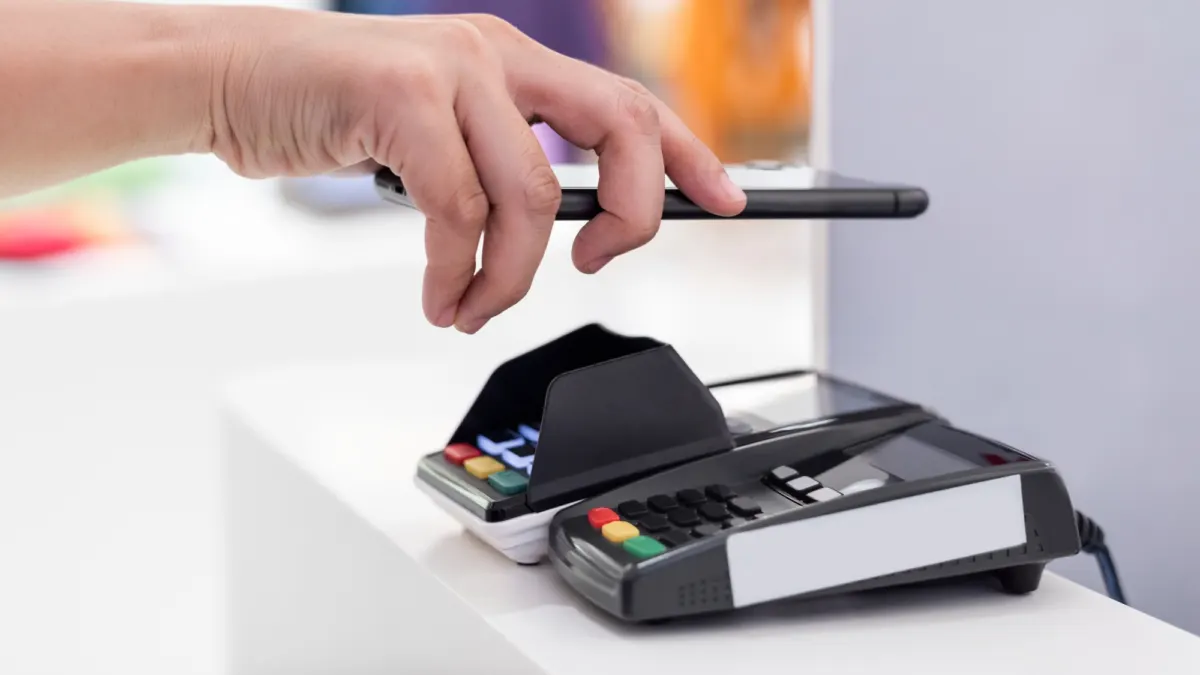
Payments is the largest and most mature part of fintech. Merchant processors let businesses accept cards online and in person; peer-to-peer apps move money between friends; cross-border specialists convert currencies at lower markups than many banks. When you tap your phone to pay, a digital wallet sends a token (a stand-in number) rather than your real card number, which reduces fraud if a merchant is hacked.
Lending and buy now, pay later
Online lenders use automated underwriting to approve loans in minutes. Some use data beyond a traditional credit score, such as income and employment history. BNPL services split a purchase into installments, often interest-free if paid on time. Read our guide to buy now, pay later for how those plans work and where they go wrong.
Neobanks
A neobank is a digital-only bank or banking app. Some hold their own banking license (for example, Monzo in the UK and, in the US, Varo, which received a national bank charter in 2020); many others are technology companies that partner with licensed banks. Our explainer what is a neobank compares them with traditional banks in detail.
Wealthtech
Wealthtech lowered the cost of investing. Robo-advisors build and rebalance a diversified portfolio for an annual fee that is usually a fraction of a traditional advisor’s, and brokerage apps removed per-trade commissions on stocks and ETFs. See robo-advisor vs financial advisor to compare costs.
Crypto and blockchain
Crypto exchanges, wallets and stablecoins are often grouped under fintech, as is the use of blockchain technology for settlement. This corner of fintech carries different risks: crypto assets are volatile, and crypto held on a platform is not covered by bank deposit insurance.
How Fintech Companies Make Money
Many fintech products are free to use, so it is worth knowing how the company actually earns revenue. Common models include:
- Interchange fees. Each time you pay with a debit or credit card, the merchant pays a fee, and part of it goes to the card’s issuing bank. Neobanks that offer free debit cards typically share this revenue with their partner bank. In the US, debit interchange is capped for banks with $10 billion or more in assets under the Durbin Amendment (the Federal Reserve’s Regulation II), while smaller banks are exempt. That exemption is one reason many fintechs partner with smaller banks.
- Transaction and processing fees. Payment processors usually charge merchants a percentage of each sale plus a small fixed fee. Money transfer services charge a fee and may add a markup to the exchange rate.
- Interest income. Lenders earn the difference between what they charge borrowers and what their funding costs. Apps that hold customer cash can also earn interest on those balances.
- Subscriptions. Premium tiers with extra features, higher limits or perks.
- Asset-based fees. Robo-advisors charge a percentage of the money they manage each year.
- Order routing and spreads. Some US brokerage apps receive payment for order flow, where market makers pay to execute customers’ trades. Crypto platforms often earn a spread between buy and sell prices. Payment for order flow is banned or restricted in the UK and EU.
- Merchant fees. BNPL providers mostly earn from fees charged to retailers, plus late fees or interest on some plans.
- Business-to-business software. Infrastructure and regtech firms sell APIs and software to banks and other fintechs.
Understanding the business model tells you where the costs hide. A “free” trading app may earn from order routing, a “free” transfer may include an exchange-rate markup, and a “no-fee” loan may rely on late fees. For a framework on judging the companies themselves as investments, see our guide to evaluating fintech stocks.
Example: Suppose a robo-advisor charges 0.25% a year and you invest $20,000. The annual fee is $20,000 × 0.0025 = $50, plus the expense ratios of the funds it holds. A traditional advisor charging 1% on the same balance would cost $20,000 × 0.01 = $200 a year. On $200,000, the gap widens to $500 versus $2,000 a year.
Fintech vs Bank: Key Differences
The line between fintechs and banks is blurring, since banks build apps and some fintechs become banks. But the core differences still matter to you as a customer.
| Feature | Traditional bank | Fintech company (non-bank) |
|---|---|---|
| License | Bank charter; supervised by banking regulators | Often a money transmitter, lender or e-money license, or relies on a partner bank’s charter |
| Deposit insurance | Deposits directly FDIC-insured (US) or FSCS-protected (UK) up to the limit | The company itself is never FDIC-insured; coverage may pass through to you only if funds sit at an insured bank and records are correct |
| Product range | Broad: checking, savings, mortgages, loans, cards, wealth | Usually focused on one or a few products |
| Fees and rates | Can be higher, especially at large banks | Often lower fees and higher savings rates, funded by lower costs or growth spending |
| Speed and user experience | Improving, but often slower account opening | Fast sign-up and modern apps |
| Customer support | Branches and phone support | Often app chat only |
| Longevity | Established institutions | Many startups; some fail, are acquired or change products |
Is Fintech Safe? Regulation and Deposit Protection
Fintech is regulated, but the rules depend on what the company does and where it operates. A US payment app typically needs state money transmitter licenses; a lender needs lending licenses and must follow consumer-lending laws; a broker is overseen by the SEC and FINRA. In the UK, firms are authorized by the Financial Conduct Authority (FCA), and in the EU payment and e-money firms are licensed under EU payments law, while crypto firms fall under the MiCA regulation.
How FDIC pass-through insurance works
In the US, FDIC insurance protects up to $250,000 per depositor, per insured bank, per ownership category if an insured bank fails. When you deposit money through a non-bank app, the app usually places it in a pooled “for benefit of” (FBO) account at one or more partner banks. The FDIC says your money can qualify for pass-through insurance only if the funds actually sit at an insured bank and the records clearly show who owns how much.
The critical limit: FDIC insurance does not protect you if the fintech company itself fails. In that case, you may have to wait for a bankruptcy court process to get your money back, possibly with a loss. The UK has a similar gap: money held by an e-money institution is “safeguarded” (kept separate from the firm’s own money) but is not protected by the Financial Services Compensation Scheme.
Case study: the Synapse collapse (2024)
Synapse Financial Technologies was a middleware company that connected consumer fintech apps to partner banks, including Evolve Bank & Trust. Synapse filed for Chapter 11 bankruptcy on April 22, 2024. Its records of who owned which funds in the pooled accounts did not match the banks’ records, and tens of thousands of customers of apps that relied on Synapse, more than 100,000 by several estimates, lost access to their money for weeks or months.
According to the Consumer Financial Protection Bureau (CFPB), the partner banks found a shortfall of roughly $60 million to $90 million between the money they held and what Synapse’s records showed customers were owed. Because no bank failed, FDIC insurance did not apply. In 2025 the CFPB obtained a court judgment against Synapse and in November 2025 allocated about $46 million from its Civil Penalty Fund to compensate harmed consumers. Check the CFPB’s case page for the current status of payments.
The episode prompted regulators to look harder at bank-fintech partnerships. The Federal Reserve took enforcement action against Evolve in June 2024 over risk management in its fintech partnerships, and the FDIC proposed stricter recordkeeping rules for pooled custodial accounts later that year.
Protect yourself: before keeping meaningful money in a fintech app, find the name of the partner bank in its disclosures and confirm the bank with the FDIC’s BankFind tool. Treat any “FDIC-insured” claim as “insured if the partner bank fails,” not “insured if the app fails.” For an emergency fund or money you need for bills, an account opened directly with an insured bank or credit union is the safer choice.
Benefits and Risks of Fintech
Benefits
- Lower costs: fewer branches and more automation often mean lower fees and better rates.
- Convenience: accounts in minutes, instant transfers and 24/7 access from a phone.
- Access: mobile money and digital accounts have brought financial services to people without easy access to a bank branch, especially in developing economies.
- Competition: fintech pressure has pushed traditional banks to cut fees and improve their own apps.
Risks
- Weaker protection than it looks: deposit insurance gaps, as Synapse showed.
- Account freezes: automated fraud systems can lock accounts, and app-only support can be slow to resolve them.
- Easy credit: one-click BNPL and instant loans make overspending easier.
- Data privacy: apps that connect to your bank account can see detailed financial data.
- Business risk: young companies can shut down products, change terms or go out of business.
- Scams: instant, irreversible payments are a favorite tool of fraudsters. Treat a payment app like cash.
How Fintech Is Changing Money
Several shifts are already visible. Payments are getting faster: real-time systems such as the UK’s Faster Payments, Brazil’s Pix and the US FedNow Service settle transfers in seconds. Open banking rules let you share your bank data securely with apps you choose; the UK and EU adopted them first, while the US Consumer Financial Protection Bureau finalized a data-access rule in 2024 that has since faced legal challenges and review. Embedded finance is putting payments, loans and insurance inside non-financial apps, from ride-hailing to online stores. And AI is being used for fraud detection, underwriting and customer service.
At the same time, the line between bank and fintech keeps moving. Several fintechs, including SoFi and LendingClub, have acquired or obtained bank charters, while large banks have copied fintech features. For a wider view of the sector, visit our fintech hub.
Bottom Line
Fintech is technology-driven financial services: payments, lending, digital banking, insurance, investing, compliance software and crypto. It often brings lower fees and better apps, but many fintechs are not banks, and FDIC pass-through insurance does not protect you if the app company fails. Use fintech products for what they do well, read the disclosures to find out which bank holds your money, and keep your essential savings in a directly insured account.
Sources
- FDIC – Banking With Third-Party Apps
- FDIC – Deposit Insurance
- Consumer Financial Protection Bureau – Synapse Financial Technologies, Inc. enforcement action
- Federal Reserve – Regulation II (Debit Card Interchange Fees and Routing)
- Office of the Comptroller of the Currency – Responsible Innovation
- Financial Conduct Authority (UK) – Innovation
- World Bank – Fintech and the Future of Finance
Frequently asked questions
What is fintech in simple terms?
Fintech is short for financial technology: using apps, software and data to provide financial services. Examples include mobile payment apps, online lenders, app-only banks, robo-advisors and crypto exchanges.
What is the difference between a fintech and a bank?
A bank holds a banking charter, takes deposits directly and is supervised by banking regulators, so deposits are insured up to the limit. Many fintechs are technology companies that partner with banks to hold your money. They often offer lower fees and better apps, but your protection depends on the partner bank arrangement.
What are some examples of fintech?
Well-known examples include PayPal and Stripe (payments), SoFi and Affirm (lending and buy now, pay later), Chime, Revolut and Monzo (neobanks), Lemonade (insurance), Betterment and Robinhood (investing), Plaid (open banking) and Coinbase (crypto).
Is my money safe in a fintech app?
It depends on the setup. If the app places your money at an FDIC-insured partner bank with accurate records, you are covered if that bank fails, up to $250,000. You are not covered if the app company fails, as Synapse customers learned in 2024. Check the disclosures for the partner bank's name.
How do fintech companies make money?
Common sources are interchange fees on card purchases, payment processing fees, interest on loans or customer balances, premium subscriptions, fees on assets managed and fees paid by merchants. Some brokerages also receive payment for order flow in the US.
What happened with Synapse?
Synapse was a middleware firm linking fintech apps to partner banks. It filed for bankruptcy in April 2024, and mismatched records left many app users unable to access their funds, with a shortfall of roughly $60–90 million according to the CFPB. In November 2025 the CFPB allocated about $46 million from its Civil Penalty Fund for affected consumers.
Keep learning
Best Fintech Stocks for the Long Term: How to Evaluate Them
The best fintech stocks for the long term combine durable revenue growth, loyal customers, controlled credit losses and real profits.…