How to Stop Overdraft Fees: 9 Habits That Keep Your Account Positive
To stop overdraft fees, opt out of debit card overdraft coverage, link a savings account as backup, set low-balance alerts and keep a small buffer in checking.
In this guide
The fastest way to stop overdraft fees is to remove the bank’s permission to charge them: opt out of overdraft coverage for debit card and ATM transactions, then link a savings account as a backup and set a low-balance alert. Those three steps take about 15 minutes. The habits below handle the rest, from deposit timing to asking for refunds.
This guide is written for US checking accounts, where overdraft rules come from federal regulations and each bank’s own fee schedule. If you bank in the UK or EU, the mechanics are different (arranged overdrafts there are priced as credit with an interest rate), so check your own bank’s terms. Everything here about rules is dated, because overdraft policy in the US has changed several times since 2010.
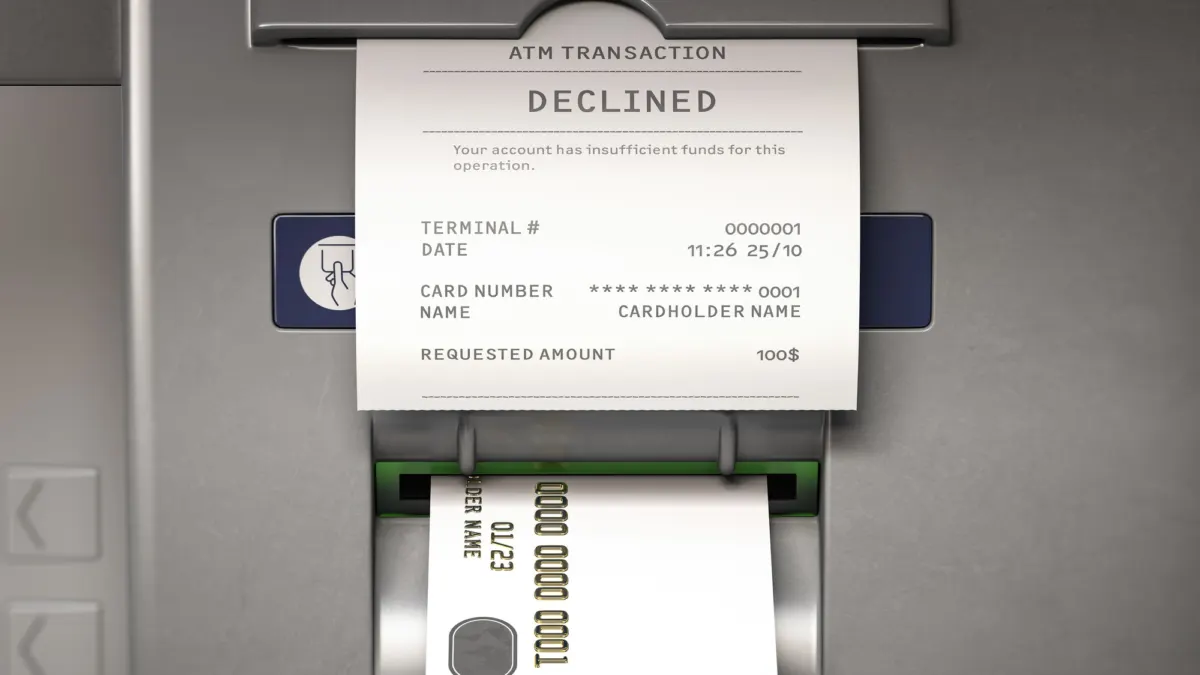
Overdraft fees look small on a statement, but they are one of the most expensive forms of short-term borrowing there is, as the worked example below shows.
How overdraft and NSF fees work
An overdraft happens when a transaction posts to your account for more money than you have available. Your bank has two choices. It can pay the transaction anyway, leaving you with a negative balance and usually charging an overdraft fee. Or it can reject the transaction and, at some banks, charge a non-sufficient funds (NSF) fee, sometimes called a returned-item fee.
Either way, the fee is a flat dollar amount per transaction, not a percentage. That is what makes it so costly on small purchases. A $4 coffee and a $400 rent check can trigger the same fee. Many banks also cap the number of fees per day (often three to six) and some add an extended overdraft fee if your balance stays negative for several days in a row.
Available balance vs ledger balance
Your bank decides whether you are overdrawn using your available balance: money you can spend right now, after subtracting pending card transactions and holds on recent deposits. Your ledger balance (sometimes called current or posted balance) only counts transactions that have fully settled. If you check your ledger balance and think you have $200, but $150 of debit purchases are still pending and a $100 check deposit is on hold, you may actually have far less available. Always look at the available figure in your app.
Which transactions can overdraw you
- One-time debit card purchases and ATM withdrawals: covered by the federal opt-in rule explained below.
- Checks: can be paid into overdraft or returned with an NSF fee.
- ACH payments (automatic bill pay, loan autopays, transfers): same as checks.
- Recurring debit card charges such as subscriptions: banks often treat these like ACH payments, so they may be paid into overdraft even if you have opted out.
How to stop overdraft fees: the 15-minute setup
The first three habits are one-time settings. Do them today and most fees become impossible or rare.
Habit 1: Opt out of overdraft coverage for debit and ATM (Regulation E)
Since 2010, a federal rule known as Regulation E (specifically 12 CFR 1005.17) has required US banks and credit unions to get your affirmative consent, called an opt-in, before charging overdraft fees on ATM withdrawals and one-time debit card purchases. If you never opted in, the bank must decline those transactions when you are short instead of charging you.
The catch: many people opted in when they opened the account, often by ticking a box in a stack of paperwork. Others clicked “yes” to a prompt during an online application. You can revoke that consent at any time.
- Log in to your bank app or website and look for “overdraft settings,” “debit card coverage” or similar.
- Choose the option that declines debit card and ATM transactions when funds are short.
- If you cannot find the setting, call the bank and say: “I want to opt out of overdraft coverage for ATM and everyday debit card transactions.” Ask for written confirmation.
Opting out means a purchase may be declined at the register, which costs nothing. The CFPB found in its 2014 research that opted-in accounts were hit with far more overdraft fees than accounts that had not opted in. Keep in mind that the opt-out does not cover checks and ACH payments, so the remaining habits still matter.
Tip: Opting out stops fees on debit and ATM transactions only. A check, an autopay or a recurring subscription can still overdraw your account or trigger an NSF fee. Pair the opt-out with a linked backup account and alerts.
Habit 2: Turn on overdraft protection with a linked account
The phrase overdraft protection confuses people because banks use it for two different things. The first is “standard overdraft coverage,” where the bank pays the transaction and charges the full fee. The second, and the one you want, is a linked-account transfer: when your checking balance would go negative, the bank automatically pulls money from your savings account, a second checking account, or a line of credit.
Many banks do these transfers for free. Others charge a transfer fee, which is usually well below a standard overdraft fee. Check your bank’s fee schedule. If your bank charges for transfers, it may still be worth it as a last line of defense, but your goal is to almost never use it.
Two cautions. First, a linked credit card or credit line works, but it can carry a cash-advance fee and interest from day one. Second, the backup only helps if it has money in it. A linked savings account with a $3 balance protects nothing. That is why the next habit matters.
Habit 3: Keep a buffer in checking
A buffer is a fixed amount you treat as zero. If your buffer is $200, you act as if your account is empty when the balance hits $200. Timing errors, forgotten subscriptions and slow-posting checks then eat into the buffer instead of triggering a fee.
How big should it be? A practical starting point is your largest single automatic payment or one week of typical spending, whichever is larger. If that feels impossible right now, start with $50 and add $10 to $25 a paycheck. A small buffer is the first step toward a full emergency fund, which is what ultimately ends the paycheck-to-paycheck cycle that causes most overdrafts.
How to avoid overdraft fees week to week
Habit 4: Set low-balance and large-transaction alerts
Almost every US bank app offers free push or text alerts. Set at least these three:
- Low-balance alert at your buffer amount (for example, $200), so you know before you go below it.
- Large-transaction alert for any debit over a set amount, which also helps you spot fraud.
- Deposit alert, so you know exactly when your paycheck or a check deposit becomes available.
Alerts only work if they reach you in time to act. Use push notifications or texts rather than email, and when a low-balance alert arrives, move money or pause spending that day. Some banks also offer an “overdraft grace period”: if you bring your balance back to zero or above by a set cutoff, often the next business day, the fee is waived. Alerts are what let you use that window.
Habit 5: Time your bills around your deposits and holds
Many overdrafts are timing problems, not spending problems. Your rent autopay goes out on the 1st, but your paycheck lands on the 3rd. You have the money, just not on the right day.
Align due dates with payday. Most lenders, utilities and card issuers let you change your due date. Move big recurring bills to two or three days after your usual payday. If you are paid every two weeks, split bills between your two paydays so neither half of the month is overloaded.
Understand deposit holds. Federal Regulation CC sets maximum hold periods for deposits. Cash, direct deposits, wire transfers and certain government and cashier’s checks generally must be available by the next business day. For ordinary personal checks, only a small first portion must be available quickly; the rest can be held for a few business days, and longer for large deposits, new accounts or repeated overdrafts. If you deposit a $1,200 check on Friday, do not assume you can spend it on Saturday. Ask the teller or check the app for the “available on” date.
Watch pending card holds. Gas stations, hotels and car rental companies often place a temporary hold that is larger than the final charge. A hotel may hold $150 per night on top of the room rate. These holds reduce your available balance until they drop off, usually within a few days.
Habit 6: Audit your automatic payments every quarter
Recurring charges are a common hidden cause of overdrafts, because you stop noticing them. Every three months, scroll through 90 days of transactions and list every recurring debit: streaming services, apps, gym memberships, insurance, loan autopays. Cancel what you do not use and put the rest on a calendar with their dates and amounts.
If you use a simple monthly budget, add these as fixed lines. Knowing that $142 leaves your account on the 15th makes it much harder to be surprised by it.
Habit 7: Track your real spending money, not your balance
The final habit is mental. Your balance is not your spending money. Your spending money is your available balance minus your buffer, minus bills due before your next paycheck.
A quick weekly check-in, 10 minutes on Sunday evening, is enough for most households: look at the available balance, list bills due in the next seven days, and decide how much you can spend. Pair this with moving any extra cash to a high-yield savings account that is linked as your overdraft backup, so the money earns interest and still protects you.
How do I stop overdraft fees once they start?
Habit 8: Ask for a refund when a fee slips through
Banks waive overdraft fees more often than most people think, especially for customers with a good history. If you get hit, call within a few days and ask politely. A simple script works:
“I was charged a $35 overdraft fee on the 12th. This is unusual for me, I have already brought the account back positive, and I have turned on alerts so it will not happen again. Could you waive the fee as a courtesy?”
If the first agent says no, ask whether a supervisor can review it. If you believe the fee was charged in error (for example, on a debit transaction you never opted in for, or because a deposit was held longer than the bank’s disclosed policy), say so specifically. You can file a complaint with the Consumer Financial Protection Bureau (CFPB) if a bank charged you in a way you believe breaks its own terms or the law.
Habit 9: Choose a fee-free checking account
The simplest way to stop overdraft fees for good is to bank somewhere that does not charge them. Since 2021, a number of large US banks and many online banks have dropped overdraft fees, NSF fees, or both. Some decline transactions you cannot cover; others offer small fee-free overdraft limits for customers with regular direct deposits. Policies change, so check the current fee schedule before you switch.
| Account option | How it handles a shortfall | Good for | Watch out for |
|---|---|---|---|
| Traditional bank, opted out of debit overdraft | Declines debit and ATM; checks and ACH may still incur fees | People who want branch access | NSF or overdraft fees on non-card payments |
| Bank or credit union with no overdraft fees | Declines or pays without a fee | Anyone who has overdrafted in the past year | Other fees (monthly maintenance, out-of-network ATMs) |
| Online bank or neobank with fee-free overdraft buffer | Covers small shortfalls (often tied to direct deposit) at no fee | People paid by direct deposit | Buffer limits can change; eligibility rules |
| Bank On certified account | Designed with no overdraft or NSF fees | People rebuilding after account closures | Fewer features, may lack paper checks |
Bank On is a national program run by the Cities for Financial Empowerment Fund that certifies low-cost accounts meeting standards such as no overdraft fees. Its website lists certified accounts by location.
Compare the whole fee schedule: a fee-free overdraft policy is little help if the account charges $15 a month in maintenance.
The true cost of one overdraft, as an annual rate
An overdraft is effectively a very short loan from your bank. When you express its cost as an annual percentage rate (APR), the number is shocking. The APR here is a rough illustration rather than a rate any bank quotes, but it shows why overdrafts are a poor way to borrow.
Example: Suppose your account has $0 available and you buy $20 of groceries with your debit card, which you had opted in to overdraft coverage for. Your bank pays it and charges a $35 overdraft fee. Your paycheck arrives three days later and brings the account back positive.
You borrowed $20 for 3 days and paid $35 for it. The cost for those three days is $35 / $20 = 1.75, or 175%.
To annualize it, multiply by the number of three-day periods in a year: 175% x (365 / 3) = 175% x 121.7 = about 21,300% APR.
Now suppose you made three small purchases that day ($20, $6 and $9) before you noticed. At $35 each, that is $105 in fees on $35 of spending.
Compare that with a credit card at 25% APR: borrowing $20 for three days would cost about $20 x 0.25 x 3 / 365 = $0.04.
The CFPB ran a similar calculation in its 2014 study of overdrafts at large banks. It found that the median debit card transaction that triggered an overdraft fee was just $24, while the median fee was $34. If you treated that as a $24 loan repaid in three days, the CFPB calculated, it would carry an APR of about 17,000%.
CFPB rules and recent changes (as of October 2026)
US overdraft rules have shifted several times, so here is a dated summary of where things stand.
- 2010: The Regulation E opt-in rule took effect. Banks need your consent before charging overdraft fees on ATM and one-time debit card transactions. This rule is still in force as of October 2026.
- 2014: The CFPB published research showing how small debit purchases led to costly fees, which fed into later policy debates.
- 2021 to 2022: Many large banks voluntarily cut or eliminated overdraft and NSF fees under public and regulatory pressure.
- December 2024: The CFPB finalized a rule for banks and credit unions with more than $10 billion in assets. It would have limited overdraft fees to $5, a fee covering the bank’s costs, or required the bank to treat overdraft coverage as a credit product with full loan disclosures. It was scheduled to take effect on October 1, 2025.
- May 2025: Congress overturned that rule using the Congressional Review Act (S.J.Res. 18, signed May 9, 2025). The rule never took effect, and the CFPB is barred from issuing a substantially similar rule unless Congress authorizes it.
The practical result: as of October 2026 there is no federal cap on overdraft fees. Your protection comes from the opt-in rule, your bank’s own policies, state laws in some places, and the habits in this guide. Rules may change again, so check the CFPB’s website for current guidance.
Bottom line
To stop overdraft fees, start with the three setup steps: opt out of debit and ATM overdraft coverage, link a savings account as backup, and turn on a low-balance alert at your buffer level. Then build a buffer, line up bills with paydays, and audit recurring charges every quarter. If you have paid more than one overdraft fee this year, switching to a fee-free account is often the single biggest fix. Overdrafts are often a sign of a thin cushion, so treat this as a stepping stone toward a budget and savings plan; our personal finance guides and our guide to paying off debt fast cover the next steps.
Sources
- eCFR – 12 CFR 1005.17, Requirements for overdraft services (Regulation E)
- Consumer Financial Protection Bureau – Know your overdraft options (handout)
- Consumer Financial Protection Bureau – CFPB finds small debit purchases lead to expensive overdraft charges (2014)
- Consumer Financial Protection Bureau – Bank accounts consumer tools
- Congress.gov – S.J.Res. 18 (119th Congress), disapproval of the CFPB overdraft rule
- Bank On – Certified accounts
Frequently asked questions
How do I stop overdraft fees on my debit card?
Ask your bank to opt you out of overdraft coverage for ATM and one-time debit card transactions, either in the app's overdraft settings or by phone. Under Regulation E, the bank then has to decline those transactions when you are short rather than charge a fee. Get written confirmation of the change.
What is the difference between overdraft protection and overdraft coverage?
Standard overdraft coverage means the bank pays a transaction you cannot afford and charges a fee, often around $35 at banks that still charge one. Overdraft protection usually means a linked account, such as savings, that automatically covers the shortfall, often for free or a smaller transfer fee. Check your bank's fee schedule for its exact terms.
How can I avoid overdraft fees if I live paycheck to paycheck?
Opt out of debit overdraft coverage, move bill due dates to just after payday, and set a low-balance alert. Build even a $50 buffer and grow it slowly. Consider a checking account with no overdraft fees so a timing mistake costs nothing.
Can I get an overdraft fee refunded?
Often, yes. Call the bank soon after the fee, explain that it is unusual for you and that the account is positive again, and ask for a courtesy waiver. If the fee broke the bank's own terms or the opt-in rule, say so and consider filing a complaint with the CFPB.
Is there a limit on overdraft fees in the US?
As of October 2026, there is no federal cap. The CFPB's 2024 rule that would have limited fees at large banks to $5 was overturned by Congress in May 2025 before it took effect. Many banks set their own daily fee limits, and some charge no overdraft fees at all.
Do overdraft fees hurt your credit score?
Overdrafts are not reported to the major credit bureaus, so a single fee does not lower your credit score. However, if a negative balance goes unpaid and the bank closes the account, it can be sent to collections and reported to checking-account screening companies, which can make it harder to open a new account.
Keep learning

Credit Score Ranges Explained and How to Build Credit Fast
Credit scores run from 300 to 850, and a good FICO score starts at 670. Build credit by paying on…
How to Pay Off Debt Fast: Snowball vs Avalanche Explained
To pay off debt fast, stop new borrowing, pay extra each month and target one debt at a time: highest…
How Much Should Your Emergency Fund Be? (With a Simple Formula)
Most people should keep an emergency fund of three to six months of essential expenses in an insured, easy-to-reach savings…