Bitcoin Mining Explained: How It Works and Is It Worth It at Home?
Bitcoin mining uses specialized computers to compete for the right to add blocks and earn new BTC. At home it rarely pays unless your electricity is very cheap.
In this guide
- What Is Bitcoin Mining?
- How Does Bitcoin Mining Work? Hashing Explained
- The Difficulty Adjustment: Why Blocks Stay at 10 Minutes
- Mining Hardware: From CPUs to ASICs
- Mining Pools: Why Almost Nobody Mines Solo
- Can I Mine Bitcoin at Home? A Worked Cost Example
- Bitcoin Mining vs Buying: Which Gets You More Bitcoin?
- Taxes on Mined Bitcoin
- Bottom Line
- Sources
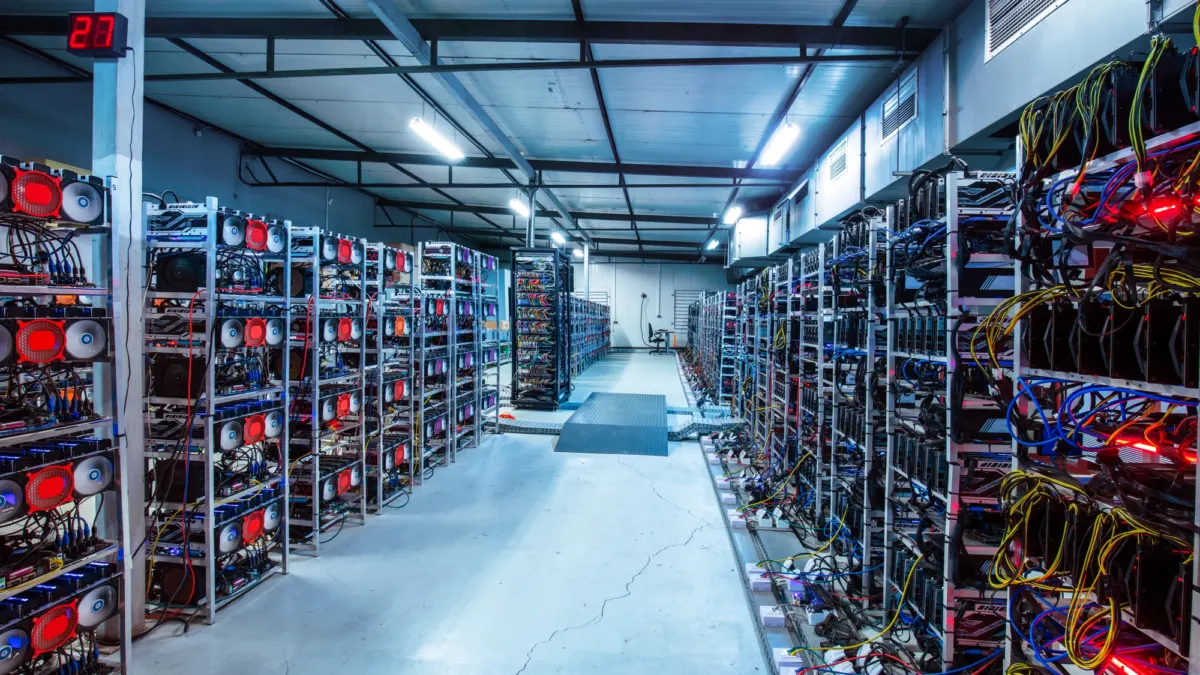
Bitcoin mining is the process of using specialized computers to compete for the right to add the next block of transactions to Bitcoin’s blockchain. The winner earns newly created bitcoin plus the fees in that block. For beginners, the short answer on profitability is this: mining at home rarely pays unless your electricity is very cheap, because you are competing against industrial farms that buy power at wholesale rates.
This guide to bitcoin mining for beginners explains what miners actually compute, how the difficulty adjustment keeps blocks coming every 10 minutes, why almost everyone mines through a pool, and what a home setup really costs. You will see a full worked example with the arithmetic laid out, and a side-by-side look at mining versus simply buying bitcoin.
If you want a refresher on how transactions and blocks fit together first, read how bitcoin works. For the full overview of the asset, see our pillar guide Bitcoin explained.
What Is Bitcoin Mining?
Bitcoin has no central server deciding which transactions are valid. Instead, thousands of independent miners collect pending transactions, bundle them into a candidate block, and race to solve a puzzle that makes the block valid. The first to solve it broadcasts the block, every node checks it, and the chain grows by one.
Mining does two jobs at once:
- It orders transactions. Once a payment is buried under several blocks, reversing it would mean redoing all that work faster than the rest of the network, which is practically impossible.
- It issues new coins. The winning miner pays itself the block subsidy (3.125 BTC per block since April 2024) plus all transaction fees in the block. This is the only way new bitcoin is created.
This system is called proof of work, because a valid block proves that a large amount of computation was spent producing it. Ethereum and many newer networks use a different approach; our comparison of proof of stake vs proof of work covers the trade-offs.
How Does Bitcoin Mining Work? Hashing Explained
The puzzle is built on a hash function called SHA-256. A hash function takes any input and produces a fixed-length, 256-bit output (shown as 64 hexadecimal characters) that looks random. Change one character of the input and the output changes completely. There is no shortcut to predict the output; you have to compute it.
Here is what a miner does, billions or trillions of times per second:
- Build a block header: the previous block’s hash, a fingerprint of all transactions in the new block (the Merkle root), a timestamp, the current target, and a number called the nonce.
- Run the header through SHA-256 twice.
- Compare the result to the target, a very large number set by the network. If the hash is below the target, the block is valid. If not, change the nonce (or another field) and try again.
A hash below the target starts with a long run of zeros, which is why people say miners are “looking for leading zeros.” Each attempt has a tiny, fixed probability of success, so mining works like a lottery where every hash is a ticket. The number of hashes a machine can compute per second is its hashrate, measured in terahashes per second (TH/s, trillions) for single machines and exahashes per second (EH/s, quintillions) for the whole network.
The Difficulty Adjustment: Why Blocks Stay at 10 Minutes
If more miners join, blocks would come faster. Bitcoin prevents that with the difficulty adjustment. Every 2,016 blocks (about two weeks), each node compares how long those blocks actually took with the target of 20,160 minutes, then moves the target up or down proportionally. A single adjustment can change difficulty by at most a factor of four.
- Blocks came too fast (more hashrate joined): the target gets smaller, so a valid hash is harder to find.
- Blocks came too slow (miners switched off): the target gets bigger, so blocks get easier.
The practical consequence for you: the network issues roughly the same number of bitcoin per day no matter how much hardware joins. Total network hashrate first reached about 1,000 EH/s (one zettahash) around the start of 2026 and has hovered near that level through much of the year, so any single machine’s share is tiny. Your income depends on your share of total hashrate, and that share shrinks whenever others add machines faster than you do.
Mining Hardware: From CPUs to ASICs
In 2009, people mined on laptop processors (CPUs). Graphics cards (GPUs) took over around 2010–2011, then a few years later came ASICs: application-specific integrated circuits built to compute SHA-256 and nothing else. Today ASICs are the only practical way to mine bitcoin; a top gaming GPU produces tens of thousands of times fewer hashes per watt.
The number that matters most is efficiency, measured in joules per terahash (J/TH): how much energy a machine uses for each trillion hashes. Lower is better.
| Hardware type | Typical hashrate | Typical power draw | Practical for bitcoin today? |
|---|---|---|---|
| Laptop or desktop CPU | Megahashes per second | 50–150 W | No; expected reward is effectively zero |
| Gaming GPU | Around 1 gigahash per second | 200–450 W | No; costs far more in power than it earns |
| Small “lottery” miner (open-source single-chip boards) | About 0.5–1.5 TH/s | About 15–25 W | Only as a hobby or long-shot solo lottery |
| Current-generation air-cooled ASIC | About 200 TH/s | About 3,500 W | Yes, if electricity is cheap enough |
| Hydro- or immersion-cooled ASIC | 300–500+ TH/s | 5,000–8,000+ W | Mostly industrial; needs special cooling |
Figures are typical ranges for illustration; check manufacturer specs for any specific model. Newer ASIC generations arrive every year or two and make older machines less competitive.
Mining Pools: Why Almost Nobody Mines Solo
With one ASIC against a network of roughly 1,000 EH/s, your machine would find a block on average about once every 95 years (the math is in the next section). That is a lottery, not an income. A mining pool fixes this by combining the hashrate of thousands of miners and splitting the rewards according to how much work each contributed.
Pools measure your work with shares: hashes that meet an easier, pool-set target. They prove you are working without needing to find a full block. Common payout methods:
- FPPS (Full Pay Per Share): the pool pays a steady expected amount for each share, including an estimate of fees, and absorbs the luck risk. Fees are usually higher.
- PPS (Pay Per Share): similar, but pays for the subsidy only, not transaction fees.
- PPLNS (Pay Per Last N Shares): you are paid only when the pool actually finds blocks, so income is lumpier but fees are often lower.
Pool fees typically range from 0% to about 4%. A handful of large pools find most blocks, which is a centralization concern the Bitcoin community debates actively.
Can I Mine Bitcoin at Home? A Worked Cost Example
To answer whether you can mine bitcoin at home profitably, you need five inputs: your hashrate, the network hashrate, the reward per block, the bitcoin price and your electricity price. Every number below is hypothetical and rounded so the arithmetic is easy to follow; plug in live figures from a mining calculator before spending any money.
Example: one ASIC miner at home
Assumptions: a 200 TH/s machine drawing 3,500 W; network hashrate of 1,000 EH/s; average reward of 3.15 BTC per block (3.125 subsidy + 0.025 fees); a pool fee of 2%; a bitcoin price of $100,000; hardware cost of $3,500.
Step 1: your share of the network. 200 TH/s ÷ 1,000,000,000 TH/s (1,000 EH/s) = 0.0000002, or 0.00002%.
Step 2: bitcoin earned per day. 144 blocks × 3.15 BTC = 453.6 BTC paid to all miners each day. Your share: 453.6 × 0.0000002 = 0.00009072 BTC. After the 2% pool fee: 0.00009072 × 0.98 ≈ 0.0000889 BTC.
Step 3: revenue in dollars. 0.0000889 × $100,000 ≈ $8.89 per day, about $267 per 30-day month.
Step 4: electricity cost. 3.5 kW × 24 hours = 84 kWh per day.
- At $0.17 per kWh (close to a typical US residential rate): 84 × $0.17 = $14.28 a day. Net result: $8.89 − $14.28 = −$5.39 a day, a loss of about $162 a month.
- At $0.06 per kWh (cheap off-peak or industrial-style power): 84 × $0.06 = $5.04 a day. Net: $8.89 − $5.04 = +$3.85 a day.
Step 5: break-even power price. $8.89 ÷ 84 kWh ≈ $0.106 per kWh. Above that, the machine loses money every day it runs.
Step 6: hardware payback. At $0.06 power: $3,500 ÷ $3.85 ≈ 909 days, about 2.5 years, and that assumes nothing changes.
Things will change, and mostly against you:
- Difficulty tends to rise. If network hashrate grows 30% over a year, your daily bitcoin output falls by about 23% (1 ÷ 1.3 ≈ 0.77).
- The next halving, expected around 2028, cuts the subsidy to 1.5625 BTC. In this example, revenue would drop to roughly $4.45 a day, below the $5.04 electricity cost even at cheap power. Our guide to the bitcoin halving explains the schedule.
- Price can move either way. A higher bitcoin price helps; a 30% fall would turn the cheap-power case into a loss.
Practical problems at home
- Noise: air-cooled ASICs commonly run at 70–80 decibels, roughly a vacuum cleaner that never turns off.
- Heat: a 3,500 W miner is effectively a 3.5 kW space heater. That can be useful in a cold winter, but costly to cool in summer.
- Wiring: most full-size ASICs need a 240 V circuit (in the US) on a dedicated breaker. Have an electrician check before plugging one in.
- Rules and leases: check your tenancy agreement, local noise rules and your power company’s terms.
Watch out for cloud mining offers. Websites that sell “mining contracts” with guaranteed daily returns are a common scam pattern. If the promised returns beat what the arithmetic above allows, the money is likely coming from new customers, not from mining.
Bitcoin Mining vs Buying: Which Gets You More Bitcoin?
For most people, the fair comparison is not “mining versus nothing” but “mining versus spending the same money on bitcoin directly.” Using the example above, with $0.06 power and nothing changing for a full year:
Example: $3,500 spent on a miner vs on bitcoin
- Buy bitcoin: $3,500 ÷ $100,000 = 0.035 BTC on day one, minus a small trading fee.
- Mine for a year: 0.0000889 × 365 ≈ 0.0324 BTC gross. Electricity: $5.04 × 365 ≈ $1,840, which at $100,000 is worth about 0.0184 BTC. Net: about 0.0140 BTC, plus a used machine worth less every month.
In this simplified case, buying delivers about 2.5 times as much bitcoin after one year, without noise, wiring or maintenance. At $0.17 power, mining would leave you with less money and no net bitcoin at all.
| Factor | Mining at home | Buying bitcoin |
|---|---|---|
| Upfront cost | Hardware, wiring, cooling | Only the purchase plus fees |
| Ongoing cost | Electricity every day | None (optional wallet or storage) |
| Main risk | Rising difficulty, halvings, hardware obsolescence, price | Price |
| Effort | Setup, monitoring, repairs, noise | Low |
| Contributes to network security | Yes | No |
| Coins with no purchase history | Yes, freshly mined coins | No; most exchanges require identity verification |
Mining can still make sense if you have stranded or very cheap power, can use the heat, or simply want to support the network as a hobby. If you just want exposure to bitcoin’s price, see how to buy bitcoin safely, or compare a bitcoin ETF vs buying bitcoin directly.
Taxes on Mined Bitcoin
In the US, the IRS treats mined bitcoin as ordinary income equal to its fair market value on the day you receive it. When you later sell or spend it, any change in value from that day is a capital gain or loss. If mining is a business rather than a hobby, self-employment tax may apply, though you may also be able to deduct costs such as electricity and equipment depreciation.
Other countries handle mining differently; in the UK, for example, HMRC looks at whether the activity amounts to a trade. Keep records of every payout and its value on the day received. Our plain-English guide on how crypto is taxed covers the details, and a tax professional can confirm how the rules apply to you.
Bottom Line
Bitcoin mining is a global lottery in which machines guess SHA-256 hashes, the difficulty adjustment keeps blocks near 10 minutes, and pools turn rare wins into steady small payouts. At home, profit comes down to one number more than any other: your electricity price. Run the arithmetic with live figures, stress-test it for rising difficulty and the 2028 halving, and compare it honestly with simply buying. For many beginners, mining is a better hobby than investment.
Sources
Frequently asked questions
How does bitcoin mining work in simple terms?
Miners bundle pending transactions into a block and repeatedly hash it with a changing number until the result falls below a target set by the network. The first to succeed adds the block and earns the subsidy plus fees. It is essentially a lottery where each hash is a ticket.
Can I mine bitcoin at home on my computer?
Technically yes, but a laptop or gaming GPU would earn effectively nothing and cost more in electricity. Bitcoin is mined with specialized ASIC machines, and even those are usually unprofitable at typical residential power prices.
How long does it take to mine 1 bitcoin?
It depends on your share of network hashrate. Using our hypothetical example, a 200 TH/s machine earning about 0.0000889 BTC a day would take roughly 11,000 days, or about 30 years, to accumulate 1 BTC, and longer as difficulty rises and halvings cut the reward.
Is bitcoin mining worth it for beginners?
Usually not as an investment. Unless you have electricity below roughly $0.06 to $0.08 per kWh, a use for the heat, and a tolerance for noise, buying bitcoin directly tends to deliver more bitcoin per dollar with far less risk and effort.
What is a bitcoin mining pool?
A pool is a group of miners that combine their hashrate and share the rewards in proportion to the work each contributes. It turns a very rare solo win into small, frequent payouts, in exchange for a pool fee.
Is bitcoin mining taxable?
In the US, mined bitcoin counts as ordinary income at its market value on the day you receive it, and selling it later can create a capital gain or loss. Rules differ by country, so check your local tax authority's guidance.
Keep learning
Bitcoin Halving Explained: Dates, History and What It Means for Price
A bitcoin halving cuts the new BTC paid to miners in half every 210,000 blocks (about four years). The last…
How to Buy Bitcoin Safely: A Beginner’s Step-by-Step Guide
To buy bitcoin as a beginner, open a regulated exchange account, verify your ID, fund it by bank transfer, buy…

How Does Bitcoin Work? A Simple Step-by-Step Explanation
Bitcoin works by having you sign payments with a private key; nodes verify them and miners add them to the…